AP (ADVANCED PLACEMENT) BIOL GY
BIOLOGY NEWS
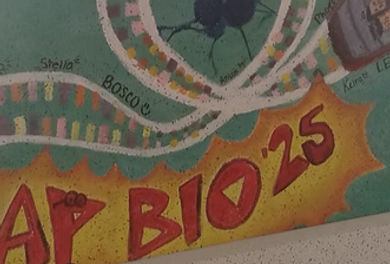
AP (advanced placement) Biology Article
Equivalent as a first year university biology course.

Biology curricular competency article
An article of the skill that students has developed
overtime and the skills biology needs.

Biology interview article
An article of the teachers interview of questions related to biology

Biology Subject article
An article about Biology and its benefits of learning it
-
Unit 1: Chemistry of life
-
Unit 2: Cells
-
Unit 3: Cellular Energetics
-
Unit 4: Cell communication and Cell cycle
-
Unit 5: Heredity
-
Unit 6: Gene expression & regulation
-
Unit 7: Natural selection
-
Unit 8: Ecology
AP stands for advanced placement. In Palmer AP classes are only offered when you're in grade 12.
Overall, if you're looking for an academic challenge and want to pursue more opportunities then AP might be a good choice for you. Since AP will be highly beneficial towards your admissions for universities & colleges because it is the highest & hardest classes that high schools can offer. If you're not looking for something hard and want to a chill high school senior experience then AP might not be for you.
Even though AP is greatly beneficial for applying to colleges and universities it is not an easy feat. The cons of AP would be:
What is AP biology?

AP biology is equivalent to college level classes. AP classes are used to pursue college level coursework credits. In conclusion AP biology is equivalent to a college class, and it's considered one of the more challenging AP's.
What are the benefits of AP?
AP classes are free but the AP exams costs money. The exams are referenced on your school record. The base of the exam fees are usually around $99.
Having a good mark on your AP classes can also help you apply for scholarships. It can also:

ALL ABOUT THE COURSE
-
increase admission chances
-
displays that you're able to handle college level work
-
-
let you experience college level classes
-
So it is easier to transition from high school work to college level work
-
-
provide more opportunities, and earn college credits
-
can allow you to skip introductory courses & save on tuition.
-
Disadvantages of AP
-
Much harder and complex than regular high school work. Can add more stress and pressure on top of your regular courses.
-
Harder to keep up rather than with regular courses
-
The cost of AP exams (each AP exam is around $99 and can add up quickly with multiple exams)
-
Some colleges/universities don't accept AP, so check if the university/college will accept AP's before taking.
-
AP's has a score range from 1-5, so if you don't get a grade from 4-5 you won't be able to get college course credit.
In AP bio you will be able to learn the skills:
-
Designing experiments and procedures to test a prediction or theory
-
Collecting & analyzing data
-
Interpreting data to draw conclusions
-
Developing and supporting a scientific claim with evidence
Course Outline
The recommended requirements to take AP biology is you must have successfully completed the chemistry and biology highschool courses.

Course Big Ideas

Big Idea 1: Evolution
-
The process of science that drives diversity and the unity of life
Big idea 2: Energetics
-
The study of of energy under transformation
Big idea 3: Information storage and transmissions
-
The study of the data in the past and quantifying & prediction the success in the activities based on the past data.